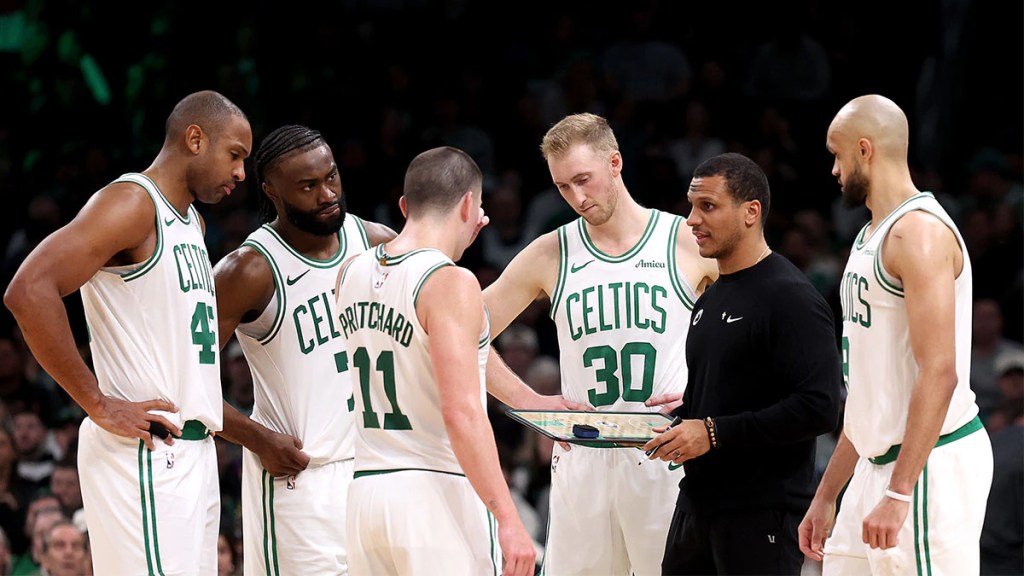
As the NBA draft approaches, marking the first offseason event for the upcoming season, all but the Oklahoma City Thunder and Indiana Pacers have already begun their offseason planning.
The reigning NBA Champion Boston Celtics could very well undergo roster reconstruction to meet the NBA’s Collective Bargaining Agreement for the 2025-26 season.
Last month, Celtics’ President of Basketball Operations, Brad Stevens, said, “The CBA has been well known for years. There are penalties associated with being at certain levels, and we are aware of them. You weigh that. You weigh where we are. You weigh everything else, then you make those decisions,”
For the 2025-26 NBA season, the projected NBA salary cap is set at $154.6 million, a 10% increase from last season’s $140.6 million. The luxury tax is currently set at $187.9 million, and in addition, the first apron is set at $195.9 million and the second apron at $207.8 million.
The NBA’s first luxury tax apron was introduced in 2011 as part of the luxury tax system to keep team payrolls in check. Penalties included restricting the team’s ability to acquire players in trades if it meant the trade would put the team over the salary cap. In the recent CBA agreement in 2023, the second apron was added with a $17.5 million trigger line. This has since placed penalties on teams’ ability to trade their future draft picks.
After a payroll of $193.3 million in the 2024-25 season, Boston exceeds the luxury tax of $170.8 million, along with being over the first apron of $178.1 million by 15.2 million and the second apron as well.
Due to the large payroll numbers, Boston was immediately punished for exceeding the first and second aprons. Not only was the team hit with a luxury tax bill of over $280 million, but their 2032 first-round pick was also frozen, and they were given restrictions on trade exceptions.
2025 outlook: Decisions need to be made
With the current 2025-26 Celtics’ roster set at $227.7 million, well over the luxury tax and first and second aprons, the team will also face being over the luxury tax line by more than $45 million. Their projected luxury tax bill will be set for $280 million — making the team roster salaries plus tax penalty well over $500 million for the season.
But after winning an NBA title last season, it was all well worth it, adding banner number 18, but following a second-round exit, finished off with a Jayson Tatum torn Achilles, who is expected to miss the majority, if not all, of the 2025-26 season, Boston has decisions to make about the immediate future.
Tatum, Jaylen Brown, Jrue Holiday, Kristaps Porzingis, and Derrick White are set to put the Celtics payroll at $173.2 million in just those five players. Brown, Tatum, and White are under contract until the 2028-29 season, making it more realistic that not just one trade will offset the team’s payroll, but more moves will have to be made, potentially taking away realistic championship goals for the 2025-26 season.
If Boston is to continue with a payroll that exceeds the second apron, the following restrictions will be implemented.
Aggregate contracts sent out in a trade: This means that if Boston wants to acquire a player of high salary, they cannot gather multiple players in a trade to match the wages of the potentially acquired player.
Use more than 100% of the traded player exception: This means the Celtics cannot exchange a player and receive players with a lower salary, provided the additional $100,000 is used to acquire players within the following year. Using 100% of a traded player exception means a team can reacquire a player or multiple players whose total salaries equal the salary of the player traded away plus an additional $100,000 without exceeding their salary cap or luxury tax.
Send out cash: Limiting the Celtics from adding cash to trades, or simply trading cash consideration for players, or for other cash.
Sign players with a salary of at least $14.1 million.
Use a preexisting trade exception: Boston will not be able to trade a player(s) with a higher salary than the one they bring, making the difference a trade exception. They will not be able to use that exception in future trades to absorb players’ salaries exceeding the cap or luxury tax threshold.
Additionally: The Celtics’ 2033 first-round pick will become frozen, along with their 2032 pick, which is already frozen, meaning it cannot be traded in any transaction.
With players like Porzingis set to become a free agent following the 2025-26 season, the Brooklyn Nets, the only team with available cap space of more than $40 million, could be a potential fit for adding to a potentially championship-building team. Still, it’s also a team that can afford the $30.7 million Porzingis is set to make this upcoming season.
Even players like Brown aren’t saved from potentially being traded, making it seem as though, other than Tatum, if allowed to offset a large amount of player contract and still keep Boston a contender, Stevens might not hold back.
For more NBA content follow @Pakzsports08 on X/Twitter


 The Pulse
Leave a comment