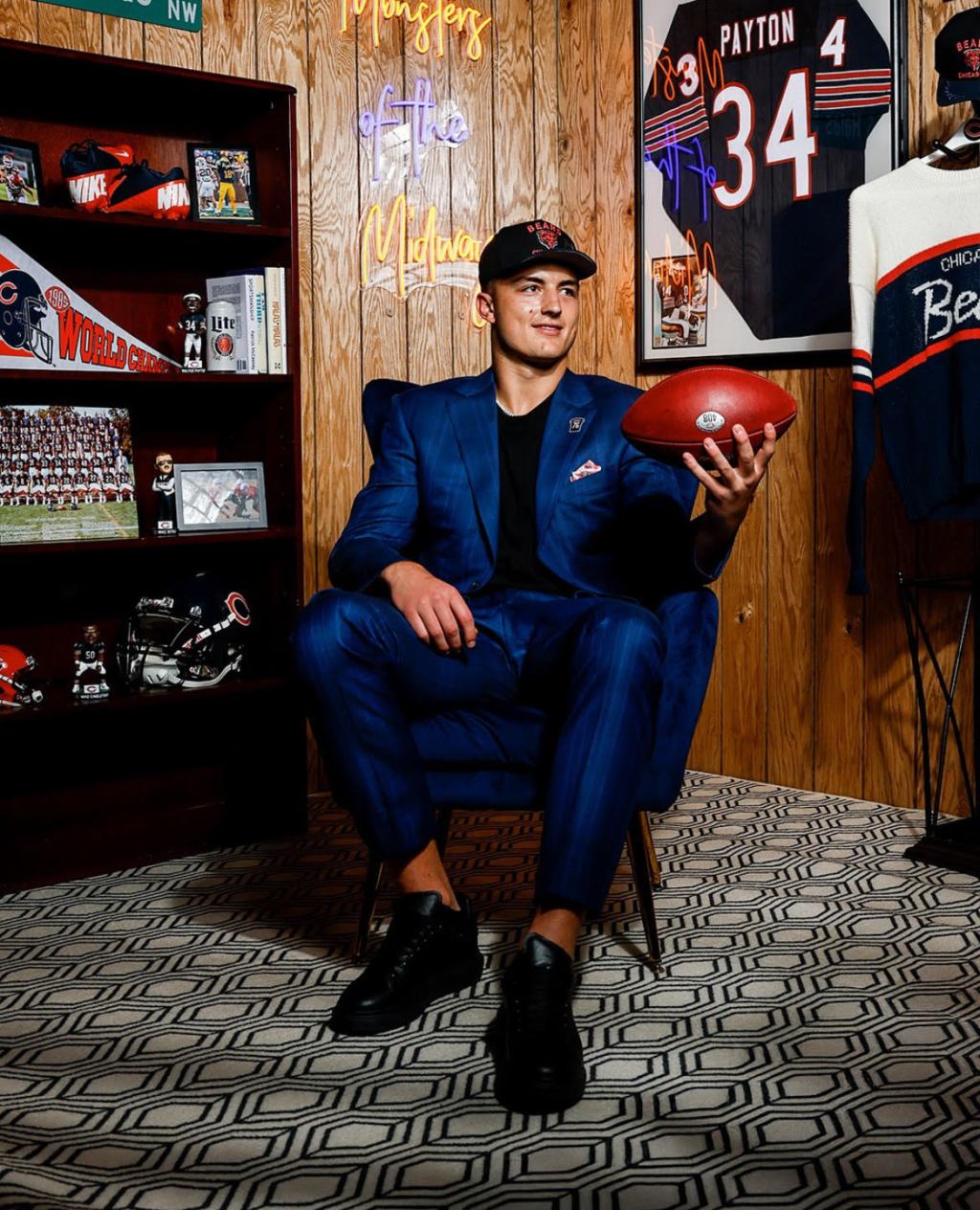
Now that reality has set in for Colston Loveland, and he’s a Chicago Bear, coming from Gooding, Idaho, was no easy task, and to become a top-10 pick is even rarer.
In a town with just one stoplight and fewer than 4,000 people, the odds of making it to the NFL are mammoth. But for Loveland the road to becoming the first NFL selection from his hometown, was paved with relentless drive, humility and grit.
Gooding isn’t known for producing professional talent. It’s a place where the dairy industry hums louder than the stadium crowds and where sports bring the community together. Loveland the middle child has an older brother, Cayden, and a younger brother, Cash, who all were raised in a competitive household where the brothers followed each other’s lead.
Cameron Andersen, Loveland’s high school football coach, said that to make it out of Idaho, all the boxes needed to be checked, and Loveland did just that.
“That’s one of the things coach {Jim} Harbaugh was impressed with when he came on his visit to Idaho, was from the lunch ladies to janitors to elementary school, middle school, high school to administration, coaches and teachers, every single person raved about how respectful, how courteous, how focused and how responsible he is,” Andersen said. “The respect that he carries himself with, that’s how Colston is.”
Loveland picked up football because Cayden played. Cayden, who played at Gooding High School, was an all-state wide receiver and defensive back who went on to play at Carroll College in Helena, Montana.
“Colston was a wide receiver because that’s what older brother was,” Andersen said. “They wore the same numbers in junior high 88.”
The two overlapped one year when Cayden was a senior and Loveland a freshman. By then, Loveland was the same size as his older brother, and both played outside receiver for Andersen.
In Loveland’s sophomore year, things started to change, starting with him hitting his growth spurt. At the start of his sophomore season, he was 6 foot-4, 195 pounds, and the decision was made to keep him at wide receiver.
The state got the best of Loveland and always brought their best efforts. Andersen and his staff needed to create new ways to get him the ball, so much so that he played five positions in a game, throwing, catching, running, and intercepting a pass for a touchdown.
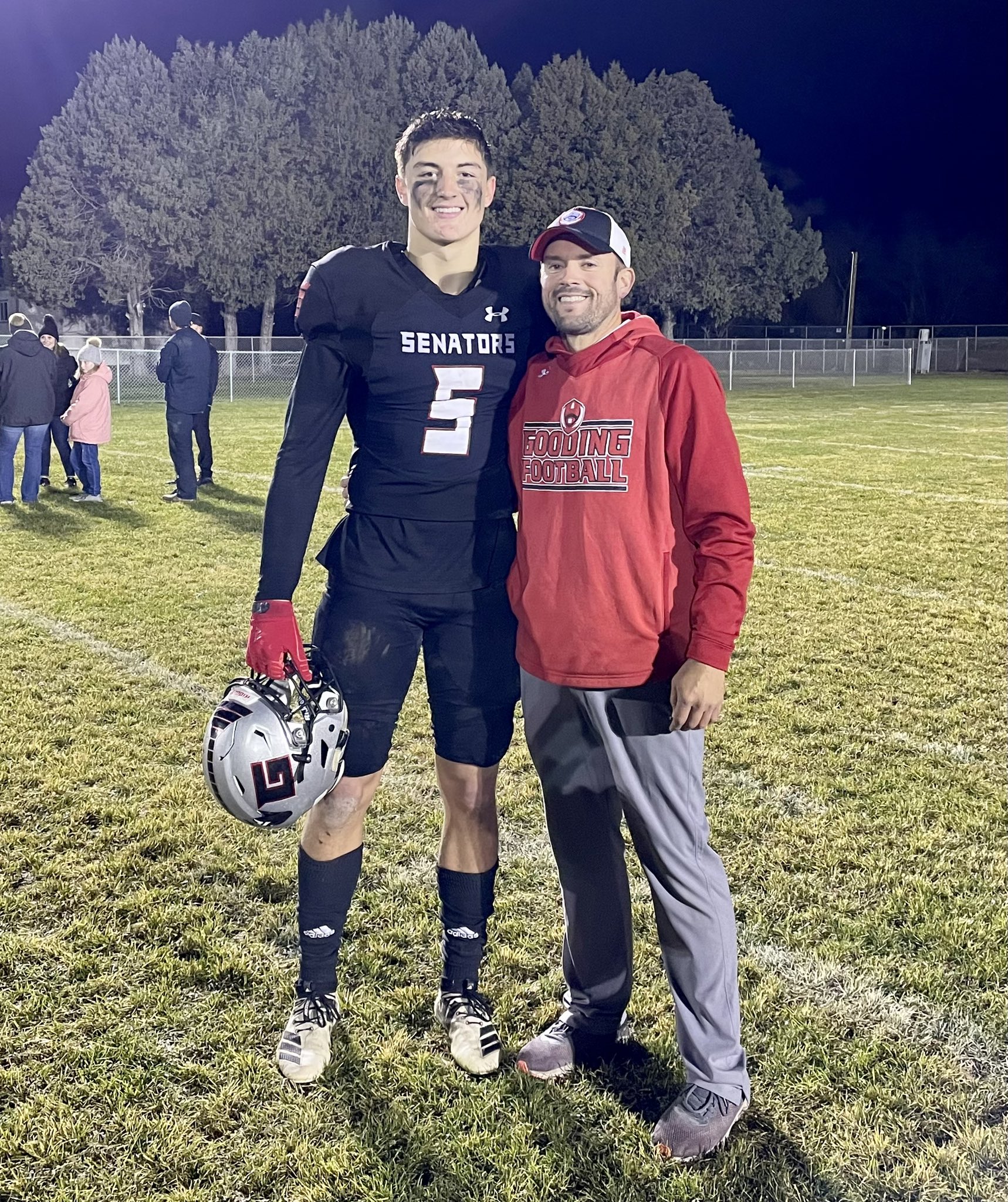
At this point, Loveland began to receive offers from the in-state schools, and when Andersen asked Loveland if they wanted to play college ball, the decision to keep him at receiver was planned. But as Loveland continued to grow, so did the possibility of playing tight end.
“It’s really hard to teach kids to become smooth, fluid route runners and be able to catch the ball. So we just kept him at receiver that year,” Andersen said.
It was a sophomore season to remember for 15-year-old Loveland, who played in a game with 19 receptions and seven touchdowns, breaking records and setting new ones. Loveland finished with 91 catches his sophomore season and played multiple games as a 6-foot-4 cornerback.
With his junior year approaching, it was time to get serious about his football future. Loveland grew again and was about 6-foot-5, 220 pounds. He started producing as a tight end, and by combining his receiver skills with his tight end body, the college offers came flying in.
Loveland was a raw talent at tight end who played multiple positions, and in a small town like Gooding, the resources were limited to coach him and mold him into a true tight end.
“Our ability to get him the ball didn’t stop us from really coaching the fundamentals in his position. We just found ways within our game plan to be creative and get him the ball,” Andersen said. “There was no way we could showcase his NFL or Big 10 talent at that level in that spot, but because of how he was utilized, the kind of kid and player he was, people could tell early on he was going to be special.”
As excited as the people of Gooding were when the first McDonald’s opened eight years ago, Loveland provided three times the excitement by playing football. In a town where the school systems along with agriculture and livestock make up most of the occupations, Loveland’s would soon be different.
When Loveland arrived on campus in Ann Arbor at the University of Michigan as a 17-year-old, the personality he carried from his upbringing in Gooding and the one Harbaugh was so impressed by showed immediately.
Andersen recalls visiting Loveland in the summer before his freshman season and seeing a board in the Michigan locker room that rewarded each player for staying on top of academics, their training on the field, in the gym, and their involvement in the community. Of the 51 days, Loveland was the only player rewarded for showing up and working every day.
“The kinds of people that come out of Gooding are just like Loveland, really humble, caring, down to earth, and hard-working,” Andersen said. “It’s the kind of product of growing up in an area like this. It develops within people the ability to make definitive choices about hard work and what you do every day consistently because it’s a way of life.”
Although Loveland has been in the NFL for just a week, his impact not only in Gooding but in the state of Idaho is already leaving a powerful motivational message.
His story has echoed throughout the state. Andersen says his phone has been blowing up from the northern parts of Idaho through the East, with coaches saying how much their players have learned of Loveland’s story and have gotten new motivation.
“What Colston’s story does for every single human is demonstrate how hard work, dedication, sacrifice, and commitment can allow you to maximize who you are and whatever it is you want to be,” Andersen said.

 The Pulse
Leave a comment